- Your cart is empty Browse Shop
Project Resources
Get access to project documents here. For exclusive details, please send us an email on info@eaffu.org or call 020 4451691
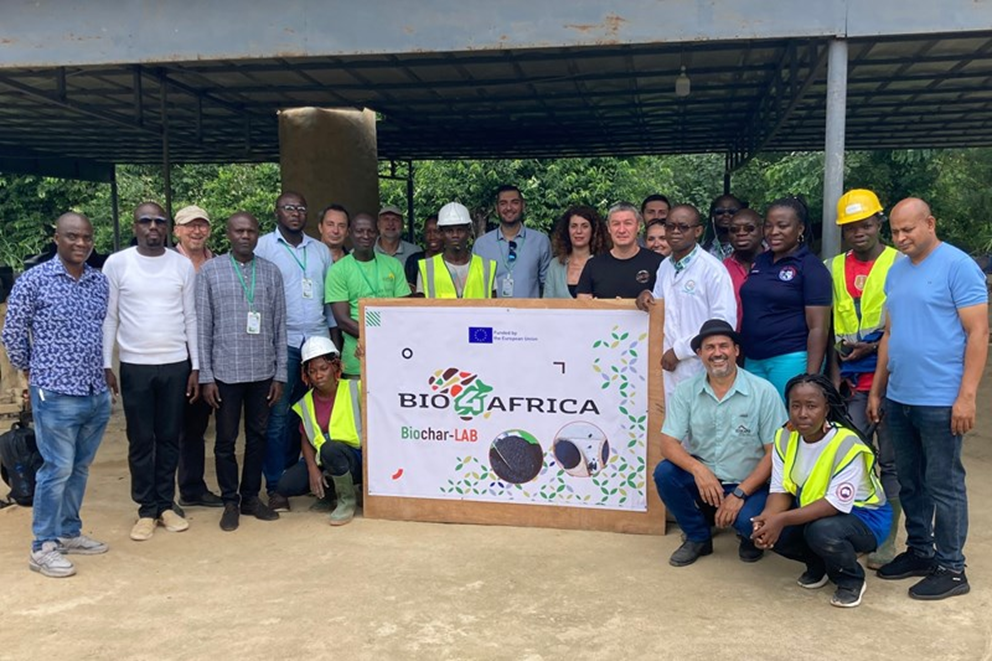
Bio-Based Solutions for Sustainable Agri-Food Systems in Rural Africa (BIO4Africa)
Project Overview
The BIO4Africa project was initiated to contribute to food and nutritional security and combat poverty in rural Africa through inclusive and sustainable development. Through the development of bio-based solutions and circular value chains, the objective was to drive the cascading use of local resources, diversify farmer incomes and contribute to an African bioeconomy.
The project focused on transferring simple, small-scale and robust bio-based technologies to smallholder farmers, including green biorefining, pyrolysis, hydrothermal carbonisation, briquetting, pelletising, bio-composites and bioplastic production — all adapted to local needs, contexts and biomass. By empowering farmers to produce a variety of higher-value, bio-based products sustainably, BIO4Africa aimed to improve the environmental, economic and social performance of forage-based agri-food systems.
The Eastern Africa Farmers Federation (EAFF) was a direct consortium partner in BIO4Africa, bringing its extensive regional network, farmer mobilization capacity, and knowledge of smallholder farming systems in Eastern Africa to the project. EAFF’s participation ensured that the bio-based technologies being piloted in Uganda were grounded in the realities of smallholder farmers and that results could be leveraged across the broader Eastern Africa region.
To pilot these technologies, BIO4Africa set up testing sites in Uganda, Ghana, Senegal and Côte d’Ivoire. During the project, more than 300 farmers and farmer groups, including small dairies, lower-income farmers, women farmer groups and transhumant pastoralists, had the opportunity to test the technologies in realistic conditions.
Funding
- EU Horizon 2020 Research and Innovation Programme
Implementation Period
2021 – 2025
Target Countries
- Uganda
- Ghana
- Senegal
- Côte d’Ivoire
Project Consortium
The BIO4Africa consortium was an interdisciplinary team consisting of 25 partners from 11 different European and African countries, including research institutes and universities, extension and advisory services, agricultural demonstration centres, private companies, technology centres and clusters. Key partners included CIRAD (France), IHE Delft (Netherlands), Munster Technological University (Ireland), GRASSA B.V. (Netherlands), the Kabarole Research and Resource Center (Uganda), the African Forum for Agricultural Advisory Services (AFAAS), the African Agricultural Technology Foundation (AATF), and the Eastern Africa Farmers Federation (EAFF).
Project Objectives
The overall objective of BIO4Africa was to diversify revenue in rural Africa through circular, sustainable and replicable bio-based solutions and business models. The project pursued six key objectives:
- Analysethe needs and context of rural communities and their agri-food value chains to identify appropriate bio-based solutions.
- Identify, develop and adaptrobust bio-based technologies that are easy to use with minimal training.
- Pilotbio-based solutions at testing sites in Côte d’Ivoire, Ghana, Senegal and Uganda to validate their performance in local conditions.
- Facilitate rural uptakethrough validated business models and hands-on business support to farmers and cooperatives.
- Documentthe potential to diversify farmer incomes through sustainable, marketable products that can be scaled up elsewhere.
- Collaborateacross academia, government, industry and civil society to build a foundation for an African bioeconomy.
Key Areas of Intervention
BIO4Africa worked across five technology streams, each adapted to specific country contexts and available local biomass:
- Green Biorefinery:Conversion of fresh green-leaf crops into protein concentrate, press cake and liquid whey for livestock feed — with the Uganda pilot being the first green biorefinery of its kind in Africa.
- Pyrolysis and Biochar:Production of biochar from agricultural residues for soil amendment, household fuel briquettes, and water purification.
- Densification Technologies:Production of biomass briquettes and pellets as cleaner cooking fuel alternatives to wood-based charcoal.
- Hydrothermal Carbonisation (HTC):Conversion of wet biomass into hydrochar for energy and soil applications.
- Biocomposites and Bioplastics:Development of construction materials and packaging from agricultural side streams.
EAFF’s Role
As a direct consortium partner, EAFF contributed to farmer engagement, stakeholder mobilization, knowledge dissemination, and the facilitation of business model development for bio-based technologies within Eastern Africa. EAFF’s membership networks in Uganda were instrumental in connecting smallholder farmers to the green biorefinery pilot at the Kabarole Research and Resource Centre in Fort Portal, and in ensuring that lessons from the project could be communicated to a wider regional audience.
Achievements and Results
Pilot Trials and Technology Validation:
- More than 60 tonnes of waste and side streams and 28 novel products rolled in and out of the BIO4Africa pilot plants during the bio-based technology trials, with individual product evaluations in the field and lab exploring performance and feasibility across a wide range of practical applications.
- The technologies were piloted with more than 300 farms and farmers’ groups in Côte d’Ivoire, Ghana, Senegal and Uganda, demonstrating real potential to improve farm incomes, environmental sustainability and circular value chains in rural communities.
Uganda — Green Biorefinery:
- The BIO4Africa green biorefinery in Fort Portal, Uganda, was the first of its kind in Africa and only the third in the world, producing press cake for improving dairy cattle milk yield, protein concentrate for improved pig and poultry performance, and liquid whey for piglet feed.
- The green biorefinery in Uganda showed good potential for improving farmer incomes due to competitive production costs, with livestock and human health also benefiting from bio-based animal feed production.
Senegal and Uganda — Alternative Fuels:
- In Senegal and Uganda, biochar produced by pyrolysis was transformed into briquettes for use as household fuel — a cleaner, more sustainable alternative to traditional charcoal produced from wood.
- Additional lab-scale trials in Senegal successfully tested the potential of biochar addition to improve biogas yield and purity.
Côte d’Ivoire and Ghana — Soil Amendment and Water Purification:
- In Côte d’Ivoire and Ghana, biochar improved selected crop yields through soil amendment. The Kapatchiva cocoa cooperative in Côte d’Ivoire installed a Brazilian pyrolysis kiln producing biochar from empty cocoa pods to counter soil degradation in cocoa plantations.
- Trials in Côte d’Ivoire included the installation of a biochar-based water purification unit in the village of Dougba, where clean drinking water is now available all year round.
High-Value Products:
- Lab tests screened green biorefinery whey juice for compounds of interest to the cosmetics industry, with findings exceeding expectations and revealing a high content of antioxidants with potential anti-ageing benefits.
Social and Economic Impact:
- Social life cycle assessments conducted across all pilot sites found that new jobs were created and new skills developed, with the sustainability potential rated as very good across all three assessed technologies.
- Investigations into technology transfer opportunities revealed that the bio-based technologies are well suited to the needs and bioresources of many other African countries and could benefit the food, energy, construction materials and mining sectors.
Knowledge and Open-Access Resources:
- BIO4Africa created an open online catalogue of 80+ technologies suitable for rural African contexts, as well as an open-access feedstock database that supports evidence-based bioeconomy deployment across the pilot countries.
- Multiple peer-reviewed scientific publications were produced and submitted to leading international journals, contributing to the global evidence base on African bioeconomy solutions.
Through BIO4Africa, EAFF strengthened its engagement in the emerging field of bioeconomy and circular agriculture helping to connect smallholder farmers in Eastern Africa to practical, climate-resilient technologies that turn agricultural waste into new sources of income and sustainable livelihoods.