- Your cart is empty Browse Shop
Project Resources
Get access to project documents here. For exclusive details, please send us an email on info@eaffu.org or call 020 4451691
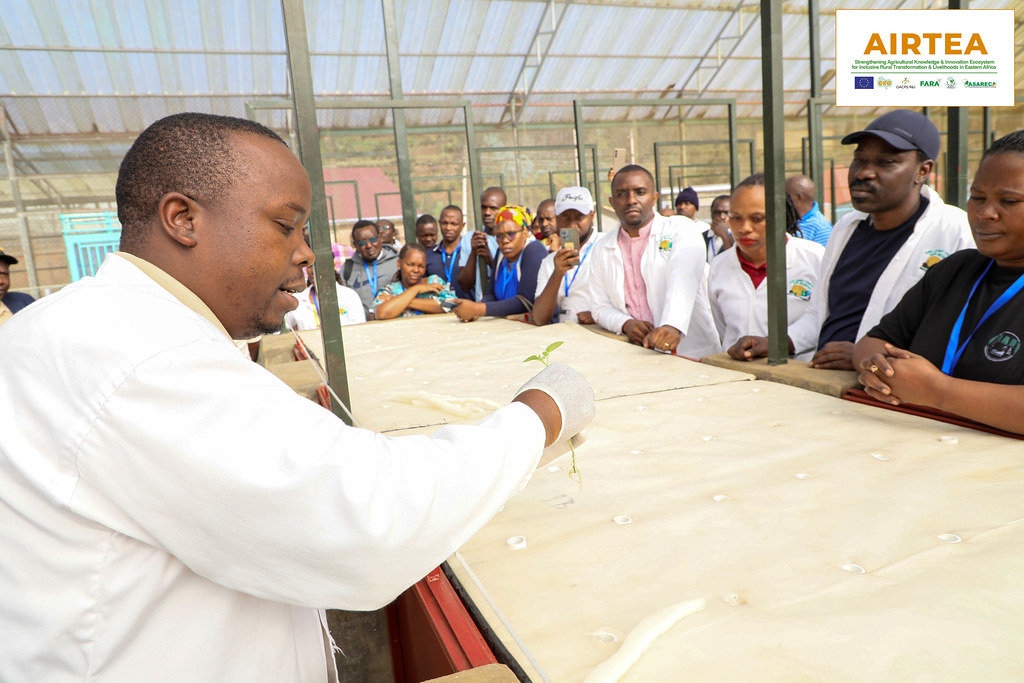
Strengthening Agricultural Knowledge and the Innovation Ecosystem for Inclusive Rural Transformation and Livelihoods in Eastern Africa (AIRTEA)
Project Overview
The Strengthening Agricultural Knowledge and the Innovation Ecosystem for Inclusive Rural Transformation and Livelihoods (AIRTEA) project in Eastern Africa was a regional initiative implemented under the OACPS Research and Innovation Programme, with the Eastern Africa Farmers Federation (EAFF) serving as a key consortium partner. The project was funded by the European Union through the Organisation of African, Caribbean and Pacific States (OACPS) and coordinated by the Forum for Agricultural Research in Africa (FARA).
AIRTEA addressed a critical gap in Eastern Africa’s agricultural development: while smallholder farmers half of whom are women form the backbone of the region’s food systems, poor access to markets, limited adoption of agricultural technologies, and weak linkages between researchers and end-users have constrained productivity, profitability, and youth engagement in the sector. The project responded by fostering an inclusive research and innovation ecosystem, strengthening multi-stakeholder Innovation Platforms (IPs) and establishing Agricultural Business Learning Alliances (ABLAs) to connect farmers, researchers, agribusinesses, and policymakers in a shared pursuit of sustainable rural transformation.
EAFF’s role within the consortium focused on linking innovation platforms to practical solutions within national, regional and global food systems, and on ensuring that smallholder farmers particularly women and youth could access and benefit from new technologies, knowledge, and agribusiness opportunities along commodity value chains.
Funding Amount
- Total Budget: EUR 4,799,035
- EU Funding: EUR 4,079,180
Implementation Period
February 2021 – January 2025
Target Countries
AIRTEA was implemented across three countries in Eastern Africa:
- Kenya
- Rwanda
- Uganda
Project Consortium
- Forum for Agricultural Research in Africa (FARA), Ghana Project Coordinator
- Association for Strengthening Agricultural Research in Eastern and Central Africa (ASARECA), Uganda
- Eastern Africa Farmers Federation (EAFF), Kenya
Project Objectives
The overall objective of AIRTEA was to foster an inclusive research and innovation environment that contributes to sustainable agrarian livelihoods and rural transformation in Eastern Africa.
The project aimed to:
- Strengthen multi-stakeholder Innovation Platforms (IPs)
- Establish and strengthen IPs at national level to facilitate capacity building, knowledge exchange, and technology transfer along value chains.
- Promote institutionalisation of IPs and multi-stakeholder engagement across Kenya, Rwanda, and Uganda.
- Build the capacity of women and youth in agribusiness
- Strengthen entrepreneurial capacity of youth and women within IPs and ABLAs.
- Link women and youth to practical technological solutions within national, regional, and global food systems.
- Establish Agricultural Business Learning Alliances (ABLAs)
- Create national and regional ABLAs to support business development services, incubation, and mentorship.
- Increase the innovation capacity of end-users, including smallholder farmers and SMEs.
- Promote technology transfer and digital innovation
- Harness digital technologies and tools to scale up agricultural innovations.
- Build capacities in ICT and emerging digital technologies to improve production efficiencies along commodity value chains.
- Create a conducive policy ecosystem for entrepreneurship
- Improve access to technology and finance for knowledge co-creation.
- Facilitate policy dialogues with smallholder farmers, researchers, agricultural extension services, and policymakers.
Key Areas of Intervention
AIRTEA worked across three interconnected areas:
- Innovation Platforms:Establishment and strengthening of multi-stakeholder IPs at national level, facilitating capacity building, knowledge exchange, and technology transfer along priority value chains including aquaculture, dairy, and horticulture.
- Agricultural Business Learning Alliances:National and regional ABLAs providing business development, incubation, and mentorship services, with a focus on women and youth entrepreneurship.
- Technology and Digital Innovation:Development and dissemination of new technologies, mobile applications, digital extension services, and value-added products along commodity value chains.
Achievements and Results
By mid-term (October 2023), AIRTEA had delivered the following results:
Innovation Platforms:
- 30 new innovation platformsestablished across 5 counties in Kenya, 3 districts in Rwanda, and 17 districts in Uganda.
- 26 existing innovation platformsstrengthened to operate as sustainable business entities across 9 Kenyan counties, 5 districts in Rwanda, and 8 districts in Uganda.
Production, Processing and Demonstration Sites:
In Uganda: 3 dairy innovation centres, 15 indigenous vegetable production units, 3 on-farm potato demonstration sites, 8 bulking centres for certified cassava planting material, and 1 Black Soldier Fly larvae production facility for fish feed.
In Kenya: 2 improved silver cyprinid fish solar cooling and drying systems, and 9 on-farm demonstration sites for farmer-to-farmer training on potato and maize.
In Rwanda: 6 screenhouses supported to produce virus-free potato seed, 68 on-farm potato demonstration sites, and 2 centres for learning and production of agricultural extension.
New Technologies and Innovations:
- 1 mobile phone-based applicationfor farmers developed in Kenya.
- Digital applications on good agricultural practices developed and deployed.
- 2 new value-added productsdeveloped from cassava, including a nutrient-dense composite flour instant porridge.
Training and Capacity Building:
- ~800 farmers and value chain actorstrained on agricultural value-added product processing and good agricultural practices on potato, maize, indigenous vegetables, and fish.
- 456 university graduates(277 female) mentored in agribusiness of potato seed production in Rwanda.
- 12 youth(6 in Kenya, 6 in Uganda) trained on providing private agricultural extension services and developing their own business models.
- 521 farmers(192 female) trained on pest and disease management in Kenya and Uganda.
- 561 farmers(286 female) trained on using e-extension services delivered by young extension agents in Rwanda.
- 118 fisherfolktrained on group dynamics, marketing, and processing of silver cyprinid fish in Kenya.
Market Linkages:
- Farmers from 15 vegetable production unitslinked to off-takers in Uganda.
- Farmers from 8 producer groupslinked to a cassava processing plant in Northern Uganda.
- Farmers from Nakuru Cooperativein Nakuru County linked to a processor of potato chips in Nairobi, Kenya.
Knowledge Products and Publications:
- 1 gender mainstreaming training manual for inclusive multi-stakeholder processes in Africa.
- 1 workshop report on the institutionalisation of innovation platforms and government incentives for priority commodity value chains.
- 1 case study report assessing the status of innovation platforms across Kenya, Rwanda, and Uganda.
- 1 training manual on the Agricultural Business Learning Alliance (ABLA) concept.
- 2 scientific publications in international peer-reviewed journals.
Through AIRTEA, EAFF and its partners demonstrated the transformative potential of inclusive, science-led, and agribusiness-oriented approaches to agricultural innovation building lasting platforms, skills, and market linkages that continue to strengthen livelihoods and rural transformation across Eastern Africa.