- Your cart is empty Browse Shop
Project Resources
Get access to project documents here. For exclusive details, please send us an email on info@eaffu.org or call 020 4451691
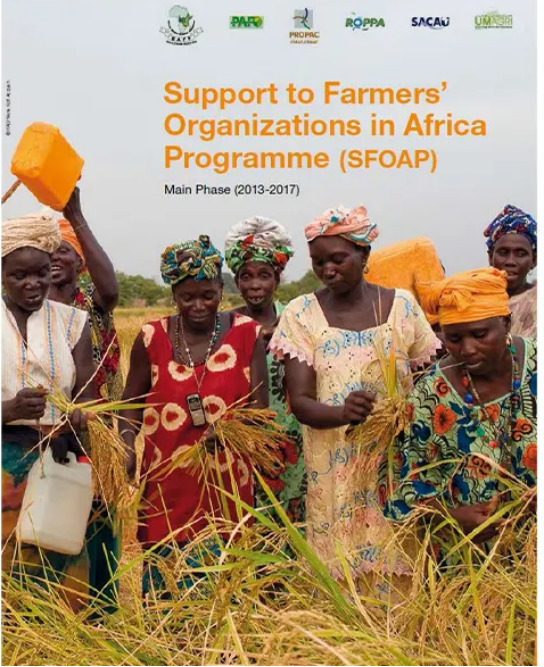
Support to Farmers’ Organizations in Africa Programme (SFOAP) — Main Phase
Project Overview
The Support to Farmers’ Organizations in Africa Programme (SFOAP) — Main Phase was a landmark multi-donor, continental programme implemented between 2013 and 2018, with the Eastern Africa Farmers Federation (EAFF) serving as one of the five regional executing agencies. Supervised and co-financed by the International Fund for Agricultural Development (IFAD), and primarily funded by the European Union, SFOAP represented the most comprehensive effort to date to strengthen farmers’ organizations (FOs) across the African continent — from grassroots cooperatives to national, regional, and pan-African networks.
Building on the successes of the SFOAP Pilot Phase (2009–2012), the Main Phase expanded the programme’s reach, deepened its impact, and introduced a new component on economic services. It supported 72 national farmers’ organizations in 52 countries representing more than 52 million smallholder farmers, of which over 26 million were women. Direct programme support targeted 44 national farmers’ organizations (NFOs) and 218 sub-national farmers’ organizations (SNFOs) across 38 African countries.
EAFF’s role within SFOAP was central: as the executing agency for Eastern Africa, EAFF channelled funds to national member organizations, coordinated regional activities, led value chain development work, and served as a model for institutional innovation — notably developing the Organizational Capacity Assessment (OCA) tool and the e-Granary digital market platform. The programme transformed EAFF and its member organizations into more stable, accountable, and professionally capable institutions with stronger voices in policy spaces and deeper integration in agricultural value chains.
Funding Amount
- Total Programme Budget: EUR 19,990,000
- European Union Contribution: EUR 15,000,000
- Swiss Agency for Development and Cooperation (SDC): EUR 2,000,000
- IFAD: USD 2,500,000
- Agence Française de Développement (AFD): EUR 1,065,750
Implementation Period
2013 – 2018
Target Countries (EAFF Region)
EAFF implemented SFOAP activities across its member countries in Eastern Africa, supporting national farmers’ organizations in:
- Burundi
- Democratic Republic of Congo (DRC)
- Djibouti
- Eritrea
- Ethiopia
- Kenya
- Rwanda
- South Sudan
- Tanzania
- Uganda
Executing Agencies
- Eastern Africa Farmers Federation (EAFF)
- Plateforme Sous-Régionale des Organisations Paysannes d’Afrique Centrale (PROPAC)
- Réseau des Organisations Paysannes et de Producteurs de l’Afrique de l’Ouest (ROPPA)
- Southern African Confederation of Agricultural Unions (SACAU)
- Union Maghrébine des Agriculteurs (UMAGRI)
- Pan-African Farmers’ Organization (PAFO)
Project Objectives
The overall objective of SFOAP was to improve the livelihoods and food security of African smallholder farmers and rural producers by transforming farmers’ organizations at national, regional, and pan-African levels into stable, performing, and accountable institutions capable of representing their members and supporting their farming enterprises.
The programme aimed to:
- Strengthen institutional and organizational capacity
- Provide FOs with strategic tools, constitutional texts, and membership databases.
- Support staffing, equipment, training, and day-to-day management.
- Build governance systems, accountability structures, and internal democracy.
- Enhance policy engagement and advocacy
- Build FO capacity to conduct policy studies, analysis, and advocacy.
- Facilitate development of common policy positions at national, regional, and continental levels.
- Strengthen FO participation in policy consultations and regulatory processes.
- Develop economic services for smallholder farmers
- Support FOs to test and scale business models for economic service delivery.
- Integrate smallholder farmers into agricultural value chains.
- Generate and share knowledge from economic pilots and business innovations.
- Support the operationalization of PAFO
- Strengthen the Pan-African Farmers’ Organization as the continental voice of African farmers at the AU and in international forums.
Key Areas of Intervention
SFOAP was structured around four core components:
- Component 1 – Institutional and Organizational Strengthening:Strategic planning tools, governance support, staff development, membership management, communication systems, and knowledge generation.
- Component 2 – Policy Engagement:Policy studies and analyses, advocacy events, common policy position development, and participation in national and regional consultation bodies.
- Component 3 – Provision of Economic Services:Value chain advisory services, business plans and scoping reports, farmer training, FO-market linkages, and documentation of economic innovations. In the EAFF region, this focused on three priority value chains Irish potato, cassava, and dairy.
- Component 4 – Pan-African Support:Institutional and governance support for PAFO, enabling the continent’s first pan-African farmers’ organization to take its place in global and continental policy dialogue.
Achievements and Results
Institutional Strengthening (Component 1):
- 101 staffemployed annually across targeted FOs, providing essential management and financial accounting capacity.
- 167 strategic documents, tools, and management systems developed, including constitutional texts, strategic plans, and membership databases.
- 35 FOsaudited annually for fiduciary accountability.
- 391 governing body meetingsheld, reinforcing internal democracy and accountability.
- 3,336 FO leaders and executivestrained through 360 training and backstopping missions.
- 985 communication productsdesigned, including websites, social media channels, and newsletters.
- Nearly 100% of regional FOsand an average of 84% of national FOs had developed all key strategic documents required for effective organizational management.
- Membership increased by more than 40%across SFOAP-targeted organizations.
- EAFF developed its Organizational Capacity Assessment (OCA) toola replicable good practice for measuring and improving institutional performance.
Policy Engagement (Component 2):
- 53 policy studies and analysesproduced to support evidence-based advocacy.
- 130 policy consultationsfacilitated, leading to 43 policy position papers
- 468 advocacy eventsorganized, with active participation in 337 external policy events.
- FOs were invited to join 256 consultation bodies and mechanisms, reflecting their growing credibility and recognition.
- EAFF successfully advanced the EAC Cooperative Societies Bill, a landmark policy achievement for the region.
- National FOs in Tanzania achieved the removal of several taxeson crop production, a direct benefit to millions of smallholder farmers.
- EAFF and ROPPA were mandated by IFAD to participate in organizing and monitoring outcomes of IFAD’s Regional Farmers’ Forum.
Economic Services (Component 3):
- 50 scoping reports, studies, and value chain action plans (VCAPs)financed to guide the component.
- 60 FO projects and business plansfunded, including training for 11,066 farmers.
- 128 contractssigned between FOs and value chain stakeholders, embedding farmers in formal market relationships.
- 127 knowledge management meetingsheld and 125 knowledge products produced documenting innovations and lessons.
- EAFF-supported value chain work in Irish potato, cassava, and dairy generated measurable increases in productivity, income, and market integration for member farmers.
- EAFF’s e-Granary digital platformwas developed as a fee-for-service tool to connect farmers to markets, contributing to long-term financial sustainability of the federation.
Partnership Development and Resource Mobilization:
- RFOs, 79% of NFOs, and partner local FOs developed a total of 198 partnershipsduring the programme.
- EUR 35,504,000in additional resources raised representing 199% of SFOAP’s total programme resources and a leverage ratio of 2.14 demonstrating that SFOAP was a powerful catalyst for attracting further investment in African FOs.
Pan-African Level (Component 4):
- PAFO was strengthened with a full-time CEO recruited in 2015, regular audits, and a foundational set of strategic documents.
- PAFO joined 5 new consultative bodiesand deepened partnerships with FAO, IFAD, AfDB, CTA, and AgriCord.
- PAFO developed its Youth Strategy, positioning the continent’s farmers’ organization as a champion for the next generation of agricultural producers.
Gender and Youth:
- Among the 1,296 staff working in SFOAP-targeted NFOs, 28% were womenand 36% were youth.
- EAFF selected gender-sensitive value chains to ensure women’s participation in economic programming.
- A new generation of FO leadership emerged, including a young woman president elected at EAFF— a milestone for gender-inclusive governance in the region.
Through SFOAP, EAFF and its national member organizations were fundamentally transformed emerging as credible, capable, and connected institutions with the tools, skills, and partnerships to advocate for smallholder farmers and support their livelihoods across Eastern Africa. The lessons and momentum of SFOAP directly shaped the successor programmes, FO4ACP and FO4IMPACT.